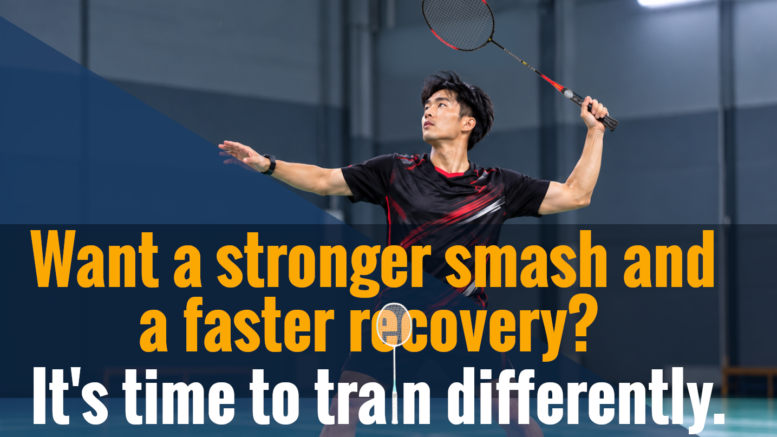
Ever felt like your smash just isn’t powerful enough, no matter how hard you swing?
Or perhaps your racket feels slower as the game goes on, especially during those fast doubles rallies?
You’re not alone.
Many badminton players experience the same frustrations. We practice our smashes, clears, drives, and defensive shots, hoping to become faster, stronger, and more consistent.
What if improving your swing isn’t just about hitting more shuttles, but also about how you train your racket movements?
That’s where a badminton training racket comes in.
Let’s explore how this simple training tool can help you develop better swing strength, control, and endurance on court.
What Exactly Is a Badminton Training Racket?
A badminton training racket looks and feels similar in shape to your regular badminton racket, but there’s one big difference.
It’s significantly heavier.
Most regular badminton rackets weigh approximately 70g to 90g, depending on the model and weight category.
Training rackets, on the other hand, come in heavier options such as 120g, 140g, 160g, 180g, and even 200g.
The additional weight creates resistance during your swings, challenging the muscles involved in controlling and moving your racket.
Think of it as resistance training designed around badminton movements.
Instead of lifting weights in the gym, you’re practicing familiar badminton swings with added resistance.
And the best part?
You’re training movements that you actually use on the badminton court.
2. Build Strength for More Powerful Smashes and Clears
Let’s be honest. Who doesn’t want a stronger smash?
You might have good technique, but when your arm starts getting tired, generating power becomes harder.
A training racket adds resistance to controlled movements such as overhead swings, clears, and smash preparation.
With gradual, consistent training, this can help develop strength and muscular endurance in your forearm, shoulder, and other muscles involved in swinging.
The goal isn’t to swing the heavier racket as hard as possible.
It’s to build the physical capacity needed to perform your badminton movements efficiently.
Remember: A powerful smash doesn’t come from arm strength alone. Proper timing, body rotation, technique, and a relaxed grip are equally important.
A training racket is there to support these skills, not replace them.
3. Train Your Racket Recovery for Faster Rallies
Picture this.
You’re playing a fast doubles match. Your opponent sends a drive straight at your body.
You manage to return it, but before your racket recovers, another shuttle comes flying back.
Sound familiar?
In badminton, it’s not only about how fast you swing.
It’s also about how quickly you can recover and prepare for the next shot.
Controlled practice with a heavier training racket can challenge your racket-handling muscles and improve your awareness of the recovery movement.
When you switch back to your regular racket, it may feel noticeably lighter and easier to maneuver.
However, true racket speed comes from a combination of technique, coordination, anticipation, and physical conditioning.
That’s why it’s important to alternate between your training racket and regular racket.
You want to develop strength without sacrificing the fast, relaxed movements badminton requires.
4. Improve Swing Control and Consistency
Have you ever hit several beautiful clears in a row, only to send the next one halfway across the court?
Or perhaps your smash timing becomes inconsistent when you’re tired.
Sometimes, the problem isn’t a lack of power. It’s difficulty repeating the same swing movement consistently.
A badminton training racket can make you more aware of how you’re moving your racket.
Because of the added weight, you may notice when you’re:
-
Rushing your swing
-
Losing balance during an overhead shot
-
Using excessive wrist movement
-
Failing to complete your follow-through
Practicing slow, controlled swings can help you concentrate on technique and movement quality.
Then, switching back to your regular racket allows you to practice the same movements at normal playing speed.
The objective is simple: Build control first, then add speed.
Remember, the training racket doesn’t automatically improve your accuracy. It’s how you practice with it that makes the difference.
5. Why Not Just Use a Squash Racket?
Some badminton players use squash rackets for resistance training because they’re heavier than regular badminton rackets.
While both can provide additional resistance, there’s an important difference.
A badminton training racket is designed around the dimensions and hitting characteristics of a badminton racket.
This matters for several reasons.
More familiar swing mechanics
A dedicated badminton training racket retains a badminton-style frame and grip, allowing you to practice more familiar swing movements.
More relevant shuttle contact
Unlike a squash racket, a strung badminton training racket can provide a contact experience closer to the equipment you normally use, although the extra weight still changes the feel and timing.
Better suited to badminton-specific drills
Squash rackets are designed for a different sport with different hitting demands.
For controlled badminton swing drills, a purpose-built training racket is generally the more relevant option.
Neither racket is automatically injury-proof, however. Excessive resistance or poor technique can overload your wrist, elbow, or shoulder.
If your objective is improving badminton-specific strength and movement, a dedicated training racket makes more sense.
6. How to Use a Training Racket Without Overdoing It
You don’t need to spend an entire training session swinging a heavy racket.
In fact, short, controlled sessions are a more sensible way to begin.
Here’s a simple routine you can try.
A 5-Minute Badminton Swing Training Routine
Step 1: Warm up with your regular racket (1 minute)
Start with gentle overhead swings, drives, and relaxed racket movements. Make sure your shoulders and wrists are comfortable before adding resistance.
Step 2: Controlled overhead swings (1 minute)
Switch to your training racket.
Practice smooth overhead swing movements, focusing on preparation, body rotation, and follow-through.
Avoid maximum-speed swings or forcing your wrist.
Step 3: Forehand and backhand transitions (1 minute)
Practice slow, controlled transitions between forehand and backhand racket positions.
Keep your grip relaxed and pay attention to racket control.
Step 4: Racket preparation and recovery (1 minute)
Practice preparing your racket for an imaginary shot, completing a controlled movement, and returning to your ready position.
Focus on smooth movements rather than speed.
Step 5: Switch back to your regular racket (1 minute)
Repeat some of the same movements with your normal racket.
Notice the difference in weight, then concentrate on relaxed, accurate movements at your usual playing speed.
Start with fewer repetitions or a lighter training racket if necessary, taking rests throughout. Stop if you experience pain or unusual fatigue.
As your conditioning improves, gradually adjust the training volume rather than immediately choosing a heavier racket.
7. Which Training Racket Weight Should You Choose?
This is one of the most important decisions.
Apacs offers several training racket weights, allowing players to select a resistance level appropriate for their experience and strength.
| Training racket | Suggested use |
|---|---|
| 120g | A sensible starting option for many adults new to weighted-racket training |
| 140g | For players already comfortable with lighter resistance training |
| 160g | Higher-resistance controlled drills for suitably conditioned players |
| 180g | Advanced resistance work under appropriate supervision |
| 200g | Very high resistance, best reserved for specifically supervised training |
These are general guidelines, not official skill classifications.
Our suggestion? Start light.
Don’t assume a 200g training racket will help you improve faster than a 120g racket.
In fact, choosing too much resistance can interfere with your technique and increase the risk of overuse injuries.
The best training racket is one that challenges you while still allowing you to maintain comfortable, controlled movements.
8. Will a Training Racket Really Make You a Better Badminton Player?
A training racket can be a useful addition to your routine, particularly if you’re looking to develop badminton-specific strength, muscular endurance, and control.
But it isn’t a magic shortcut.
Better badminton comes from combining several things:
-
Good swing technique
-
Proper footwork and positioning
-
Consistent shuttle-hitting practice
-
Strength and conditioning
-
Timing, anticipation, and recovery
Think of your training racket as one tool in your badminton improvement journey.
You still need your regular racket to develop speed, touch, accuracy, and real-game timing.
And you still need to play badminton!
Final Thoughts: Train Smarter, Not Just Harder
Everyone wants a faster swing, a stronger smash, and better control on court.
But improvement doesn’t always mean hitting harder or practicing longer.
Sometimes, it’s about adding the right kind of training to your routine.
A badminton training racket gives you a way to introduce resistance into familiar badminton movements while developing better awareness of your swing.
Start with manageable resistance, focus on proper technique, and be consistent.
Over time, those small improvements in strength, control, and coordination can support better performance on court.
Ready to add something new to your badminton training?
Explore the Apacs Badminton Training Racket Collection, available in different weights to suit your training needs.
One last question:
What’s the one thing you want to improve most in your badminton game: smash power, swing speed, defense, or control?
Share your thoughts in the comments. We’d love to hear from you!
Note: Weighted-racket training is not suitable for everyone, particularly players with existing wrist, elbow, or shoulder injuries. Seek guidance from a qualified coach or healthcare professional if you’re unsure.
Be the first to comment on "Want a Faster Swing and Stronger Smash? Here’s Why You Should Train with a Badminton Training Racket"