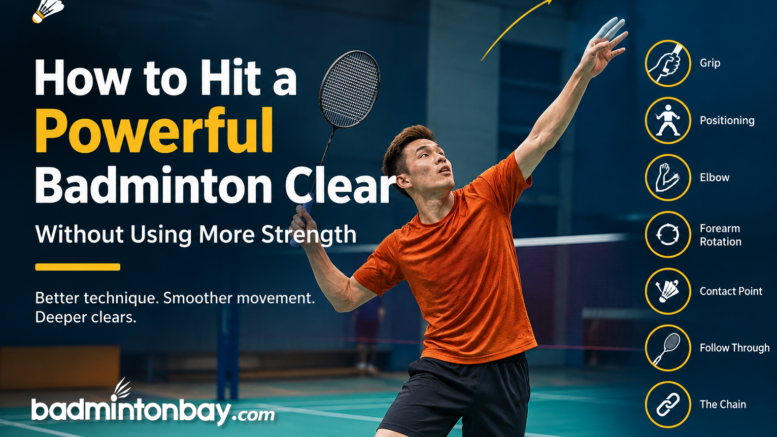
Have you ever hit a badminton clear with everything you have, only to watch the shuttle land somewhere around the middle of the court?
It can be frustrating. Your swing feels powerful, your shoulder is working hard, and yet the shuttle simply refuses to reach the back line. The natural reaction is to think, “I need more power.”
But in badminton, hitting harder isn’t always the solution. A good overhead clear is the result of several movements working together. Your grip, positioning, body rotation, elbow movement, forearm rotation, contact point and follow-through all contribute to the final shot.
When these movements are connected properly, you can generate considerably more racket speed without relying entirely on muscular strength.
Here’s how to build a better clear from the ground up.
1. Start With the Right Grip
Before worrying about your swing, check your grip.
For a standard overhead clear, begin with a basic forehand grip. Your fingers should not be clamped tightly around the racket. Keep the hand relatively relaxed, with a little space between the fingers rather than squeezing the handle continuously.
This relaxed grip gives your hand and forearm room to move naturally.
A common mistake is holding the racket too tightly throughout the entire swing. When your hand is tense, it becomes harder to accelerate the racket quickly.
Instead, think of the racket as something you control with your fingers rather than something you need to grip as tightly as possible.
The fingers can then tighten briefly at the appropriate moment during the stroke, helping to increase racket-head speed.
2. Get Behind the Shuttle
Good technique begins before you even swing.
When preparing for an overhead clear, turn your body sideways rather than facing the net squarely. Your racket-side shoulder should be positioned behind you, allowing your body to prepare for the rotation.
More importantly, try to get your body underneath and slightly behind the shuttle.
If you stay underneath the shuttle or allow it to travel behind you, you lose the opportunity to make a strong contact.
Moving into position early gives you more options and allows you to contact the shuttle at a high point in front of your head.
This is one reason experienced players often seem to have so much time. They aren’t necessarily reacting faster at the last second. They are preparing their body and getting into position earlier.
3. Prepare the Elbow
Once you’re in position, your upper body needs to prepare for the stroke.
Bring the arms up and get the racket into a position where you can accelerate towards the shuttle.
One useful way to think about the movement is to lead with the elbow.
Instead of keeping the hand permanently in front of the elbow, allow the elbow to move forward as part of the throwing-like motion.
This creates a better setup for the forearm rotation that follows.
The movement is similar to the basic throwing action used in other sports. Your body begins the movement, the elbow contributes to the acceleration, and the forearm and racket then complete the action.
The important point is that the clear isn’t produced by your hand and arm working independently. It is a sequence.
4. Use Your Forearm Rotation
Forearm rotation is one of the most important sources of racket speed in an overhead shot.
After preparing with the elbow, rotate the forearm as you extend towards the shuttle. At the same time, reach upward so that you can contact the shuttle at a high point.
This movement allows the racket head to accelerate rapidly.
You can practise this separately before putting the entire stroke together. Get into your overhead position, bring the elbow into position, and practise the forearm rotation while extending upwards.
The goal isn’t to make a huge movement. It is to learn how to create speed through a coordinated rotation.
This is also why simply swinging the entire arm as hard as possible doesn’t necessarily produce a powerful clear. A technically efficient movement can create more racket-head speed with less wasted motion.
5. Find the Right Contact Point
Timing is just as important as technique.
Ideally, the shuttle should be contacted high and slightly in front of your head.
If you hit it too early, the racket may not be in the ideal position. If you allow it to travel too far behind you, your ability to generate power and control decreases.
Think of the hitting zone as being slightly in front of your body rather than beside or behind your head.
This is also where your positioning becomes important. If you have moved properly behind the shuttle, you have a much better chance of making a clean, high contact.
Don’t wait for the shuttle to come down to a comfortable height. Move into position so that you can take it earlier.
6. Relax, Then Accelerate
A powerful clear doesn’t require you to stay tense throughout the entire movement.
In fact, excessive tension can slow the racket down.
Keep your arm relaxed during preparation, then accelerate through the hitting zone. Your fingers can tighten naturally at the point of impact, helping transfer speed into the racket.
This is why racket-head speed can matter more than simply trying to use maximum muscle strength.
You might be surprised by how far a shuttle can travel when you use a relatively compact swing with good timing and acceleration.
Start by practising at perhaps half of your maximum effort. Once you can consistently find the correct contact point and movement, gradually increase the speed.
7. Let Your Body Do Some of the Work
Your clear should involve more than your arm.
As you prepare, your weight is positioned towards your racket side. As you execute the stroke, your hips and upper body rotate, allowing your weight to transfer through the shot.
This creates a chain of movement that starts from the lower body and continues through the torso, shoulder, elbow, forearm and finally the racket.
You don’t need to consciously force every individual part. The aim is to connect the movements so they flow naturally.
When the body works together, the shot becomes much more efficient.
8. Don’t Stop at Contact
Another common mistake is stopping the racket immediately after hitting the shuttle.
A proper follow-through allows the body and racket to complete the movement naturally.
After contact, allow your arm and body to continue rotating. Your hips and upper body should participate in the movement, rather than freezing immediately after the shuttle leaves the racket.
A good follow-through also helps make the stroke feel smoother and less forced.
If your movement finishes abruptly, it can be a sign that you’re trying to generate all your power at the instant of contact rather than allowing the entire movement to flow through the shot.
The Real Secret: Connect Everything
The individual techniques are important, but the biggest improvement comes when you stop thinking of them as separate movements.
The clear is a chain:
Grip → Position → Elbow → Forearm Rotation → Contact → Follow-through
Each part prepares the next.
A relaxed forehand grip allows the forearm to rotate. Getting behind the shuttle gives you a better contact position. The elbow helps prepare the arm for acceleration. Forearm rotation creates racket-head speed. Body rotation adds momentum. Finally, the follow-through completes the movement.
When these elements work together, you don’t need to rely on a huge swing.
Practise the Movement Before Adding More Power
If your clear isn’t reaching the back line, don’t immediately try to hit harder.
Start by reducing your power and concentrating on technique.
Get behind the shuttle. Turn sideways. Prepare the elbow. Keep your grip relaxed. Reach high. Contact the shuttle in front of your head. Rotate the forearm and allow the body to follow through.
Once these movements become comfortable, gradually increase your racket speed.
The goal isn’t simply to produce the hardest possible swing. It is to produce an efficient swing that sends the shuttle deep while keeping you balanced and ready for the next shot.
That’s the real difference between forcing a clear and hitting a clear efficiently.
With the right technique, power doesn’t have to feel like hard work. It can become the natural result of putting the entire movement together.
Good clears aren’t about the brand or the price tag.
You can hit a good clear with almost any racket. What matters most is your technique, timing, and getting comfortable with the racket in your hand.
Find your rackets HERE. 👈
P.S. Want to improve your clear even more? Here are 3 simple things to remember:
1. Keep your knees bent
Stay slightly bent at the knees instead of standing upright. This helps you stay balanced and makes it easier to move quickly into position for the shot.
2. Keep your racket up
Don’t let your racket drop too low while waiting for the shuttle. Keeping it up helps you prepare your swing earlier and react faster, especially when the shuttle comes quickly.
3. Slightly tilt your body to the left when hitting if you’re right-handed
As a right-handed player, a slight tilt towards your left side during the hitting motion can help you rotate your body more naturally and improve power generation. The movement should feel smooth rather than forced.
These small adjustments can make your movement and preparation more efficient, helping you generate better shots without simply trying to use more strength.
Be the first to comment on "How to Hit a Powerful Badminton Clear Without Using More Strength"